But Soltura didn't invent this concept. Our game owes its existence to "Scoundrel", a brilliant and minimalist physical card game designed by Zach Gage and Kurt Bieg. If you haven't played the physical version of Scoundrel with a real deck of cards, we highly recommend you grab a deck and try it. It is a masterclass in game design.
When we set out to build Soltura, our goal wasn't to simply port Scoundrel to a screen. We wanted to take that perfect, tense survival foundation and evolve it into a competitive, arcade-style roguelite.
Here is a look at what we kept from the original masterpiece, and how Soltura breaks the mold to become its own beast.
The Foundation: The Great Cut
We kept Scoundrel’s most ingenious mechanic: the math of the deck.
A standard 52-card deck is perfectly balanced. But to make a dungeon crawler tense, the odds have to be stacked against you. Just like in Scoundrel, before a game of Soltura begins, the deck is purged: We remove all Red Face Cards (Jacks, Queens, Kings) and all Red Aces.
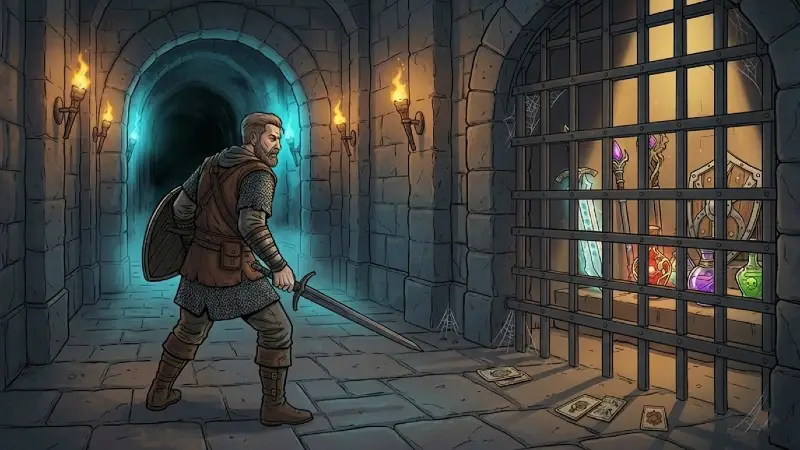
This leaves exactly 44 cards. The Spades and Clubs are the monsters. The Hearts are your health potions, and the Diamonds are your weapons. Because the highest healing/weapon cards have been removed, the math dictates that you cannot simply block or heal through every monster. You will take damage, and you must plan ahead.
That is where Scoundrel’s rules end, and Soltura’s begin.
From Survival to High-Score Hunting
In traditional Scoundrel, the goal is binary: Can you survive to the bottom of the deck? If you make it out alive, you win.
In Soltura, survival is only the beginning. We introduced a dynamic scoring engine designed to reward risk-taking. Fighting a monster barehanded hurts your HP, but it grants you points equal to the monster's rank. Do you use your weapon to play it safe, or take a blow to the face to climb the leaderboard?
We also stripped out Scoundrel's "flee" option, which allowed you to skip a hand, placing the cards at the bottom of the deck. Instead, Soltura forces you to confront the cards in the room in front of you.
Furthermore, we supercharged the combat with Chain Bonuses. If you can stack multiple monsters of equal or descending value onto a single weapon, you trigger massive point payouts (+15, +35, all the way up to +100 for a mega-chain). This turns defensive play into offensive strategy, encouraging players to hoard low-value monsters for massive combos.
The Wildcards: RPG Mechanics in a Deck
To give players more agency, Soltura introduces two powerful wildcards that function like RPG abilities.
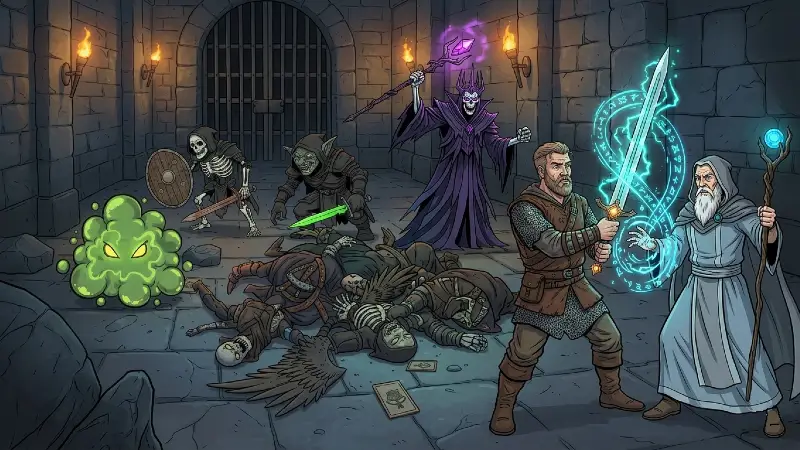
When you draw a Benevolent Joker (★), you don't just get a generic wild card. You must choose one of three distinct actions:
- Buff Weapon: Add a permanent +1 power to your equipped Diamond.
- Heal: Instantly recover 3 HP.
- Preview: Peek at the next 3 cards buried in the deck.
- Flee: Shuffle the room back into the deck, but take 1 damage.
- Blind Bet: Instantly draw and play the top card of the deck without looking.
- Swap: Trade a monster in the room with the unknown top card of the deck.
 Pro-Tip
If you manage to survive the dungeon without using your Jokers, keeping them in the room or deck grants a massive 14 Bonus Points per Joker during the endgame tally!
The Global Arena
Finally, we wanted to take the solitary experience of a physical card game and build a community around it. Soltura introduces The Gauntlet (a brutal 3-deck marathon with a single life) and the Daily Dungeon—where every player on Earth faces the exact same shuffled seed to battle for the #1 spot.
Scoundrel taught us how to survive the dungeon. Soltura asks: How gloriously can you conquer it?
Grab your sword, watch your health, and we’ll see you on the leaderboards.